Is South Africa’s tyre levy an environmental safeguard — or a policy misfire?
BY PROF PERCY HLANGOTHI
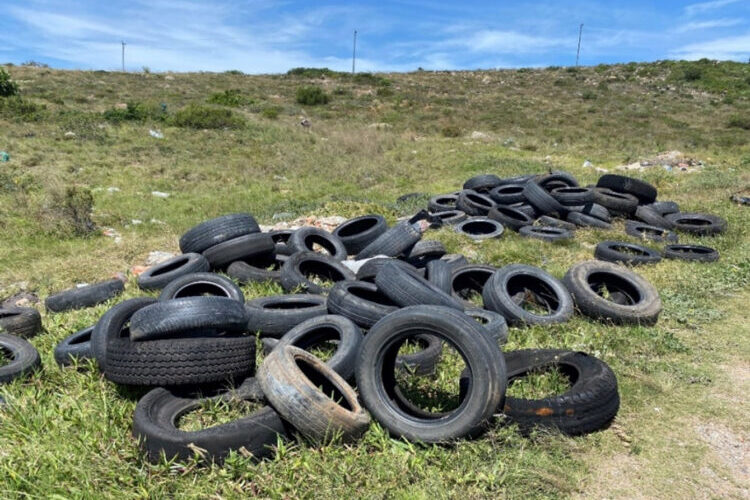
SOUTH AFRICA collects billions of rand through a tyre levy intended to prevent environmental harm, yet waste tyre stockpiles continue to grow. Each year roughly 250 000 tonnes of used tyres accumulate across the country. This while more than 12 million new tyres enter the market, each carrying a levy of R2.30 per kilogram meant to fund an effective waste-tyre management system aimed at recycling.
The principle is sound. Tyres do not biodegrade and, when stockpiled or burned, release highly toxic fumes and leach harmful substances into soil and water. Managing this persistent waste stream requires a policy instrument that is well designed and properly implemented. Unfortunately, South Africa’s waste tyre levy offers a prime example of how well-intentioned policy often degrades into dysfunction and waste.
Between 2013 and 2017, when the independent non-profit company the Recycling and Economic Development Initiative of South Africa (REDISA) operated the national waste-tyre system, the levy formed part of an Extended Producer Responsibility (EPR) framework. Producers and importers – through the levies – were responsible for funding an independent, coordinated system that not only addressed serious environmental harm, but, importantly, opened new avenues to a circular economy creating opportunities for employment throughout the value chain. Collection depots were built, thousands of jobs were created, and small enterprises were integrated into recycling.
The system not only managed waste but also built a national knowledge base around tyre and rubber science, recycling technologies, and circular-economy skills. This included research partnerships, as with Nelson Mandela University, student training, and independent tyre testing through the Product Testing Institute (PTI). REDISA’s whole-of-system approach developed technical expertise. Today, however, the tyre levy remains but the system around it has weakened. Since 2017 the levy has generated well over R5 billion, roughly R500 to R700 million each year. Yet depots are overfull and mounds of discarded tyres scar South Africa’s landscape.
The levy is collected by SARS and paid into the National Revenue Fund, meaning it becomes part of general government revenue rather than being ring-fenced and used for the stated goal for which it was collected.
Less than half of these funds end up being used for managing waste tyres, leaving a widening gap between revenue collected and environmental outcomes.
Another weakness is the levy’s flat structure. Every tyre pays the same R2.30 per kilogram, regardless of how it is designed, what materials it contains, or how long it will last. A high-quality tyre built to be retreaded two or three times – extending its life and reducing waste – carries the same levy as a cheaper tyre that may wear out quickly and be discarded after a single use.
In practical terms, durability is neither rewarded nor short lifespans penalised. Manufacturers investing in stronger casings and cleaner materials gain no advantage. The levy raises revenue, but it does little to encourage better environmental performance.
International experience shows that regulation can shape product quality. In the European Union, tyres are subject to stricter chemical standards, and certain substances restricted in EU manufacturing cannot be used or sold there. Producers must also meet clear recovery targets, and recycling rates in many member states approach 100%.
South Africa applies no comparable product-specific chemical limits on finished tyres, and the levy does not distinguish between higher and lower environmental standards. Cheaper imports manufactured under looser regimes can therefore enter the country legally. Independent testing at ports of entry is limited, meaning tyres are largely accepted based on documentation rather than verified composition or durability. If those tyres contain lower-grade materials, cannot be retreaded, or wear out more quickly, they enter the waste stream sooner – increasing environmental risk rather than reducing it.
The earlier REDISA framework recognised that sustainability depends on institutional capacity. The PTI, accredited to international standards, was established to test load, endurance and rolling resistance – the latter linked to fuel use and emissions. This capability allows regulators and industry to verify quality, support safe retreading and generate data to underpin differentiated policy. Retreading, which conserves up to 70% of a tyre’s material, only works where durability is independently certified. Today, the levy continues to be collected, but without the same integrated framework of accountability, testing and targeted reinvestment. In its current form, it functions as a flat tax rather than a fair and transparent instrument which directly addresses the problem, in this case, waste tyre pollution and dumping.
If the objective of the R2.30 tyre levy is genuine environmental protection, it must be used for that purpose and evolve. Linking the levy to the support of a waste tyre management system that is effective and independent – while also establishing measurable criteria such as durability, retreadability and material standards – would reconnect financial responsibility with real environmental outcomes.
Prof. Percy Hlangothi is director of the Centre for Rubber Science and Technology at Nelson Mandela University