Plastic Reboot: Scaling Reuse and Refill in South Africa
THE REPORT Scaling Reuse and Refill in South Africa synthesises implementation insights from reuse and refill systems currently operating locally. It focuses on reuse and refill operational evidence on what is working, under what conditions, and where there are practical opportunities for scaling and optimising these systems in the food and beverage value chain.
Produced as part of the Plastic Reboot – South Africa project – it focuses on upstream solutions: rethinking how we design, produce, and use plastic before it becomes waste. Supported by the Global Environment Facility (GEF) and co-led by UNEP and World Wildlife Fund US with implementation by UNDP and UNIDO, Plastic Reboot helps the food and beverage industry move from single-use plastics towards sustainable, circular solutions. Plastic Reboot – South Africa is one of 15 global Plastic Reboot projects.
The Department of Forestry, Fisheries and the Environment (DFFE) is the national focal point, while the national execution agency is WWF South Africa in collaboration with the Council for Scientific and Industrial Research (CSIR) and GreenCape.
Scaling Reuse and Refill in South Africa considers all three packaging tiers:
• Primary (consumer-facing)
• Secondary (grouping, distribution and handling)
• Tertiary (transport and storage).
As more support is needed to assist adoption of reuse and refill in the South African context, primary packaging is the core focus of this report.
Key insights: What is currently working in South Africa
Findings from operational reuse and refill systems in South Africa indicate that:
• Cost-driven reuse and refill systems outperform sustainability-framed alternatives
• Standardisation enables shared infrastructure
• Closed-loop systems reduce liability and operational risk
• Different tiers require different models and different support
• Controlled environments reduce complexity
• Scale requires collaboration.
• Implementation Insights on Primary Packaging from Case Study Examples
The adoption of reuse and refill models in primary packaging has the greatest potential to reduce virgin plastic intensity and address downstream plastic leakage into the environment. Therefore, case study examples highlight opportunities to reuse and refill to reduce primary packaging intensity in both low- and higher-income retail environments:
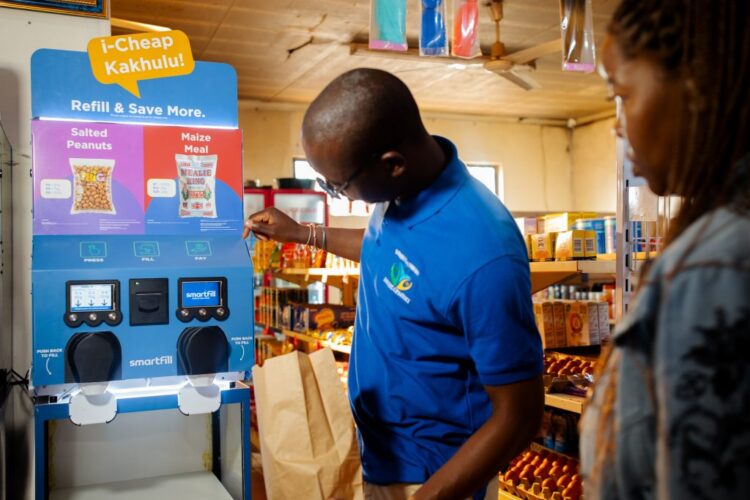
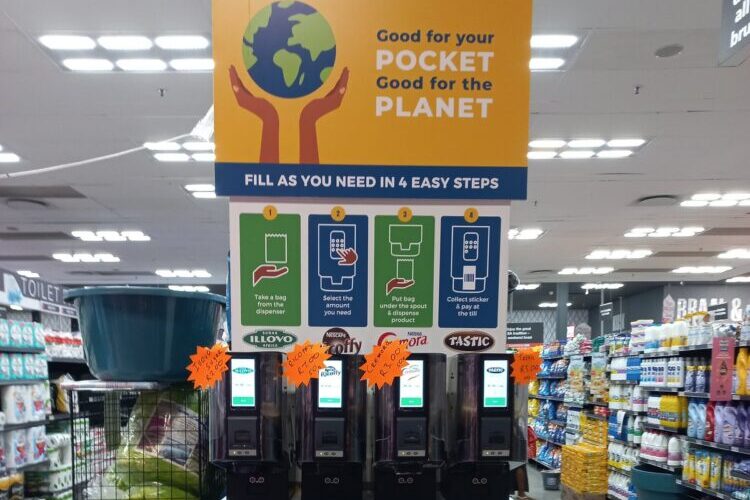
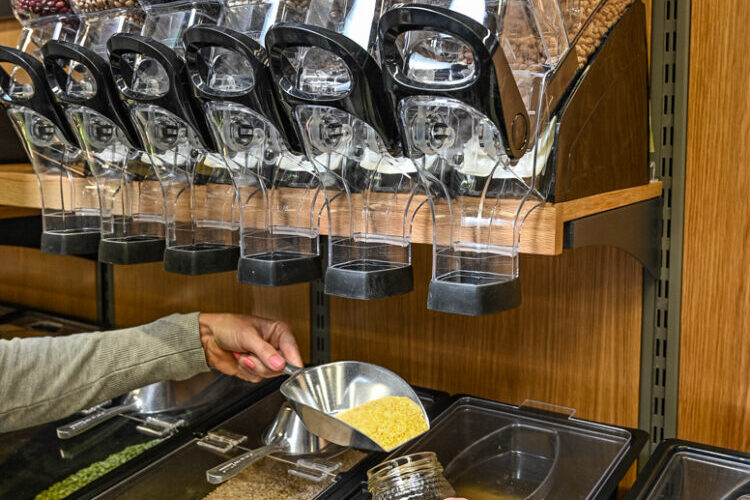
• Smartfill smart dispensers in SPAR and spaza shops: Deploying a refill system as a fully managed commercial service with on-site support to customers reduces complexity for the retailer, improves the efficiency of use for the customer and increases sales.
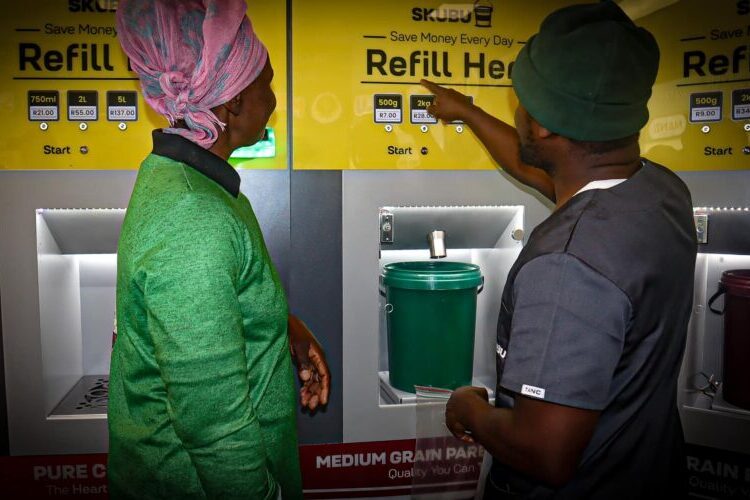
• Sonke’s SKUBU refill store: Dispensing from bulk and in smaller quantities is a significant enabler of affordability and food security in the South African context. Brands can increase access to their products by participating in bulk reuse and refill supply chains.
• Gcwalisa’s informal social franchise: Building the direct financial incentive into the system from the outset is very effective. Cost reduction is a powerful driver of adoption and, together with the affordability of small quantities, an enabler of food security. A deposit-return system provides a financial incentive for container return and enables effective closed-loop reuse.
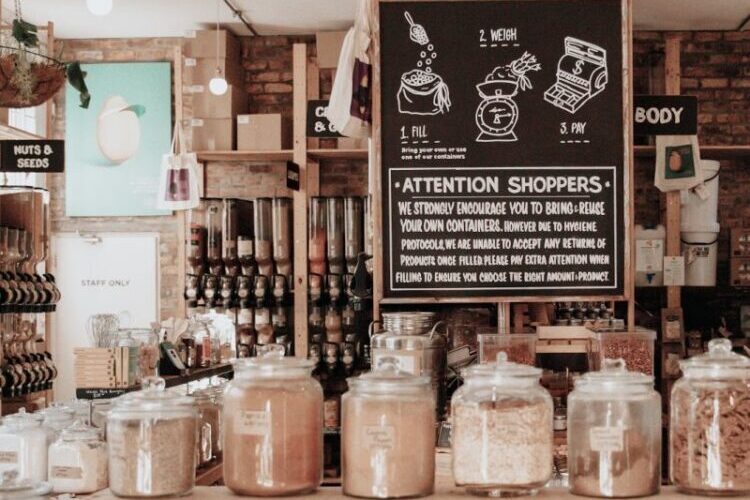
• Nude Foods zero-waste retail: Specialist zero-waste retail works in a committed, sustainability-oriented consumer segment. Scaling to mainstream retail is expected to require standardised containers and provider-managed systems, rather than expanding consumer-managed container formats.
• Pick n Pay Constantia’s plastic-packaging- free zone: Large-format retailers can operate plastic-packaging-free zones. The constraint is operational complexity at scale and continued availability of single-use alternatives in store or nearby on shelf. Removing single-use options is a stronger mechanism to drive adoption than providing refi ll options alongside them. Internationally, conventional retail success came from introducing prefilled reusable containers and establishing effective return networks.
Secondary packaging: Reducing packaging intensity in grouping, distribution, and handling
The commercial case for secondary reuse in South Africa is well established. Closed-loop and deposit-return systems have been key enablers of high return rates to date. Standardisation, pooling and packaging-as-a-service models merit further exploration to optimise secondary packaging and further reduce secondary plastic-packaging intensity.
Tertiary packaging: Reducing packaging intensity in transport and storage
For logistics companies and businesses in the food and beverage value chain that handle their own logistics, the simplest reuse models involve defined, closed-loop delivery routes with established return logistics. Conversely, more complex transport routes can benefit from packaging-as-a-service models, which offer greater operational flexibility and cost savings.
Outlook: From pilots to scalable systems
Local reuse and refill systems are already operational across all three packaging tiers. The case studies and examples show that it works when the system is designed around the right conditions, when:
• Reuse saves the consumer or business money
• The reusable assets are managed by the provider
• The environment is controlled
• The infrastructure is shared rather than duplicated.
The opportunity is to move from isolated pilots to coordinated, scalable systems adapted to South African realities.
https://plastic-reboot.org/en/projects/south-africa
www.greencape.co.za