
The evolution of the World Cup Ball (1986-2026)
THE FIFA World Cup™ has been the pinnacle of global soccer ever since the first match was played in 1930. Early years had each host nation supplying their own match ball, resulting in major inconsistencies in quality and performance. Crafted from brown leather, they were also tough to spot on black-and-white TV.
While Adidas’ creation of the iconic black-and-white Telstar for the 1970 FIFA World Cup solved the visibility issue – its distinctive pattern remaining the classic image of a soccer ball to this day – it still did not solve the inconsistencies inherent in leather balls. Variations in the natural materials and hand-crafted construction meant the ball could differ slightly in shape, weight, or performance. Concerns were raised that ball-to-ball inconsistencies could influence match performance or even the outcome of games.
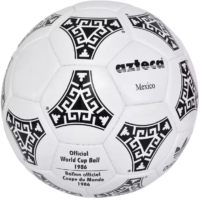
Mexico 1986: Azteca
The 1986 FIFA World Cup™ marked a turning point in soccer technology. While previous World Cup balls had gradually improved through coatings and construction, the Azteca became the first manufactured entirely from synthetic material, with the key material being polyurethane (PU). Unlike leather, polyurethane absorbs virtually no water and offers excellent abrasion resistance, flexibility, and durability. The Azteca retained the typical 32-panel stitched construction seen in previous designs, consisting of an outer polyurethane wear layer bonded to three underlying support layers. Its design was the first to pay homage to its host nation, with the ball’s distinctive triangular panel graphics featuring intricate designs inspired by Aztec art and frescoes that reflect Mexico’s cultural heritage.
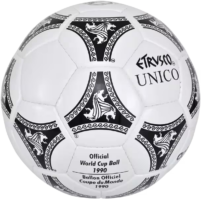
Italy 1990: Etrusco Unico
The evolution of plastic materials continued with 1990’s Etrusco Unico. A layer of closed-cell black polyurethane foam was incorporated beneath the ball’s outer shell, providing additional protection against waterlogging, increasing elasticity while reducing energy losses during impact. Like the Azteca, it drew design inspiration from the host nation’s ancient culture – 20 triangular triads gilded with a depiction of the lion’s heads.
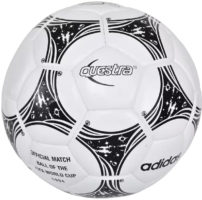
USA 1994: Questra
The 1994 Questra introduced further advances in polymer foam technology. Multiple polyurethane foam layers increased softness while maintaining structural stability. Foam density improvements and cell structure allowed ball response to be fine-tuned, balancing energy absorption during trapping with efficient energy return during striking. Inspired by the USA’s space exploration, the Questra’s triads were decorated with planets, stars and rockets. It was also significantly lighter than previous World Cup balls.
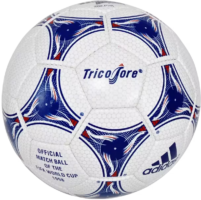
France 1998: Tricolore
France introduced the Tricolore in 1998, further refining these concepts. Enhanced synthetic foam laminates improved durability and reduced deformation under repeated impacts, while advances in polymer processing enabled more consistent manufacturing tolerances, ensuring greater consistency between match balls. The Tricolore was the first multicoloured ball, with a traditional monochrome palette updated to reflect the host nation’s traditional colours.
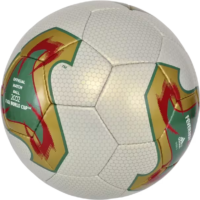
Korea/ Japan 2002: Fevernova
The 2002 World Cup marked a break with recent tradition as the triads of the previous six balls were replaced with four trigonal designs, although the familiar hexagonal and pentagonal panels remained. The hand-stitched Fevernova’s name came from a combination of the words ‘fever’ and ‘supernova’, and it boasted an improved layer of syntactic foam that provided extra cushioning for greater control and accuracy. The four trigons adorning the ball represent wind turbines in a celebration of alternative energy sources.
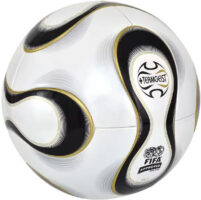
Germany 2006: +Teamgeist
The 2006 FIFA World Cup in Germany introduced perhaps the biggest manufacturing revolution since synthetic materials replaced leather, with the +Teamgeist abandoning the stitched 32-panel design in favour of 14 thermally bonded polyurethane panels. Thermal bonding makes use of heat and pressure to fuse polymer-coated panel edges without conventional stitching, creating a near-seamless surface with improved dimensional accuracy and reduced water uptake. This breakthrough depended on carefully formulated thermoplastic polyurethane (TPU) layers capable of melting and bonding while maintaining long-term mechanical strength after cooling.
Reducing the number of panels produces a more spherical ball with tighter manufacturing tolerances. Less seam length meant more consistent aerodynamics, while the bonded construction improved durability by eliminating stitch failure as a common wear mechanism.
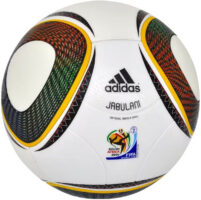
South Africa 2010: Jabulani
South Africa’s Jabulani (2010) pushed this concept further with only eight thermally bonded panels. Adorned with 11 different colours, representing the number of players and the official South African languages, its textured Grip ‘n’ Groove polyurethane surface was designed to improve grip and aerodynamic performance through controlled surface roughness. However, while the polymer engineering successfully produced an exceptionally round and durable ball, the reduced seam length significantly altered airflow, leading to unpredictable flight characteristics.
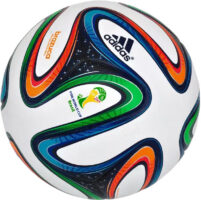
Brazil 2014: Brazuca
Therefore, the Brazuca (2014) went through a more rigorous testing process than any other World Cup ball before it, with extensive laboratory and field testing refining the polymer surface geometry and producing a ball praised for its predictable flight and excellent consistency. The design adopted six thermally bonded polyurethane panels with a deeper and more complex surface texture that stabilised airflow, with the colourful swirling lines representing traditional Brazilian wish bracelets.
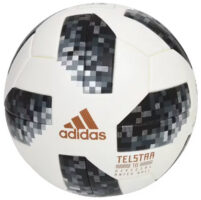
Russia 2018: Telstar 18
The Telstar 18 (2018) demonstrated how polymers were beginning to integrate with electronics, with an embedded NFC chip allowing for digital interaction with smartphones. Updating the classic Telstar design for use in Russia, the modernised Telstar was constructed from six panels thermally bonded to create a more spherical, smooth surface.
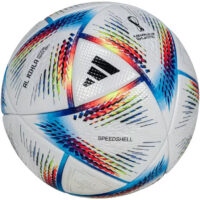
Qatar 2022: Al Rihla
Its 20-panel design, inspired by Qatar’s architecture and national flag, the 2022 Al Rihla continued the evolution of sustainable manufacturing. Its polyurethane construction incorporated waterbased inks and adhesives, reducing VOC emissions during production while maintaining high bond strength between polymer layers. An integrated inertial measurement sensor, known as Connected Ball technology and suspended within the ball, enabled real-time tracking to support semiautomated offside decisions and other officiating technologies.
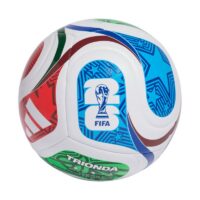
United States, Mexico, and Canada 2026: Trionda
The Trionda was used in this year’s World Cup, with its tricolour representing the national colours of all three of its host countries. It boasts several key performance innovations, such as the four-panel construction incorporating intentionally deep seams, creating a surface that produces optimal in-flight stability by ensuring sufficient and evenly distributed drag as the ball travels through the air. Additionally, embossed icons that are only visible up close elevate grip when striking or dribbling the ball in wet or humid conditions.
Ultimately, the World Cup ball has evolved into a sophisticated polymer composite, showcasing how material selection, processing technology, and design optimisation can fundamentally change the performance of a global sporting event.