
Banbury Plastic Solutions: The risks of overdosing masterbatch
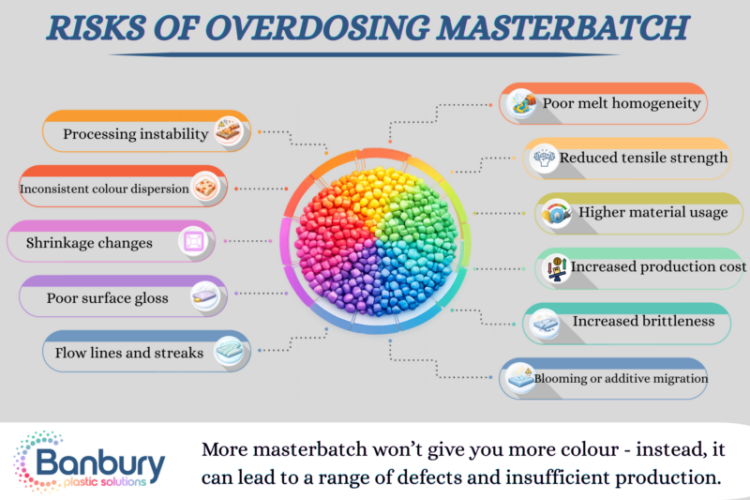
MORE masterbatch won’t give you more colour – instead, it can lead to a range of defects and insufficient production.
Manufacturers need to consider several factors to achieve the most efficient level of dosing. Masterbatch products, such as colour or additive masterbatch, tend to be significantly more expensive than the base polymer, so it makes sense to achieve an optimum dosing level. Banbury Plastic Solutions suggests convertors attend to the following key areas:
Mechanical property loss: Most masterbatches use a carrier resin that may not match your base polymer perfectly, leading to defects such as reduced tensile strength, lower impact resistance, and increased brittleness.
Surface defects: Excess pigment and additives can interfere with melt flow, leading to poor surface gloss, swirl marks, and flow lines or streaking. These surface defects can result in rejected parts, increased scrap rates, and a less consistent finished appearance.
Dispersion problems: Even though masterbatch is predispersed, overdosing can lead to specks or streaks, give an inconsistent visual finish, and cause re-agglomeration of pigments. These issues can increase scrap, slow production and make it harder to maintain a consistent standard from batch to batch.
Processing instability: Higher additive loading changes melt behaviour, leading to possible die build-up, poor melt homogeneity, and altered MFI. This can lead to unstable production conditions, more machine adjustments and unnecessary downtime.
Blooming/migration: Can occur when excess additives are no longer fully absorbed into the polymer and begin moving to the surface over time. This may affect overall product appearance, lead to smearing or a greasy feel, as well as a migration of additives to the surface. In severe cases, it can also lead to rejected products and reduced shelf appeal.
Dimensional & shrinkage issues: Happens when excessive masterbatch changes the way the polymer cools and contracts after processing. This can cause sink marks, warping, and changes in shrinkage rates. Over time, these issues can lead to assembly problems, higher reject rates and increased material waste.
Weld line weakness: Weld lines can become more noticeable when excessive masterbatch interferes with the way melt fronts join together during processing. This can lead to increased brittleness, weakening knit/weld lines, which means parts are more likely to fail at certain stress points. In some cases, it may reduce the overall strength of the product and increase the risk of cracking or breakage.
Cost impact: Using more material than necessary increases raw material costs without improving product quality. This means more masterbatch is being used with no improvement in colour, which is ultimately a pure waste of product and money. Cost impact is one of the biggest risks of overdosing masterbatch.